Tuesday, July 17, 2018

Lazuli Bunting

These are not great photos, but they do prove that I have had a Lazuli bunting visit my home! This is the first Lazuli bunting I've seen, and I now know that there is a mated pair nesting in a big Douglas Fir on my property. The two birds come down to forage in our backyard either early in the morning or late in the afternoon. I'll try to get better images if the opportunity permits it.


"House Finch Eye Disease"

This unfortunate American goldfinch appears to be infected with the House Finch Eye Disease. He's been hanging around the property for about a month and seems to be faring okay. Interestingly, the other goldfinch don't chase him away from the feeder, as they do to the other goldfinch (we have at least two breeding pairs visiting our feeder). I don't know the prognosis of the disease, but I hope this little guy gets better!


Wounded Juvenile Bald Eagle

I was enjoying the buzzes of the local cicadas, when I noticed a large bird walking through my corn patch! To make a long story short, it ended up being a 10-week old newly fledged Bald eagle. It was near starved to death and very dehydrated. Here's a picture of it peeking through the fence, and the video was taken by my wife Robbie. The raptor rescue organization (Birds of Prey NW) we contacted asked that I move the bird from the sheet I caught it with into a cardboard box. 


At the last update I received from Birds of Prey NW was that the bird has a broken wing, but the bird was a good candidate to be rehabilitated and released. I'll keep you updated as information is received. And, I'm exited to report, is that the bird will be released on our property once it is in a condition to returned to the wild. 


Black-chinned hummingbird

Here's a few Black-chins visiting my feeder. 


It's an adult male, as evidenced by the dark patch ("black chin") under the bill. In the light, the patch (formally, gorget) turns a brilliant electric lilac color.

American Robin

Fencing makes a great place to build a nest!
This is the father, as is shown by the black head and bright breast. Females have gray heads and softer orange breasts.

The hatchlings will bet a steady supply of worms, bugs, and cherries.

Thursday, July 7, 2016

Spotted Towhee

Another one of my favorite birds. They act like mice in the underbrush. But the males will expose themselves to sing their very quite and simple songs. Not the best images, but they're what I was able to take of these shy and elusive birds.


Tree Swallows

A pair of Tree swallows were nesting under a boat cover at Glengary Bay, on Lake Pend Oreille in North Idaho near where I moor my sailboat. Hopefully the babies will fledge before the boat owners decide to uncover their boat. You'll see the nest as indicated by the feathers clinging to the canvas cover, just under the notch that accommodates the aft bar of the forward pulpit.  


Here is a Violet-green swallow for coloration comparison. The two species are often confused by new birders. Also note the limited coloring around the eyes, as compared to the Tree swallow.


Swainson's Thrush

One single bad shot, but I chased this bird for so long that I felt victorious just getting the image that I did. 


Orange-crowned Warbler

Although these are common birds, their very non-descriptive plumage makes them difficult to identify. And they are busy birds! I chased this one for a good long while and was lucky to get the images that I did.  


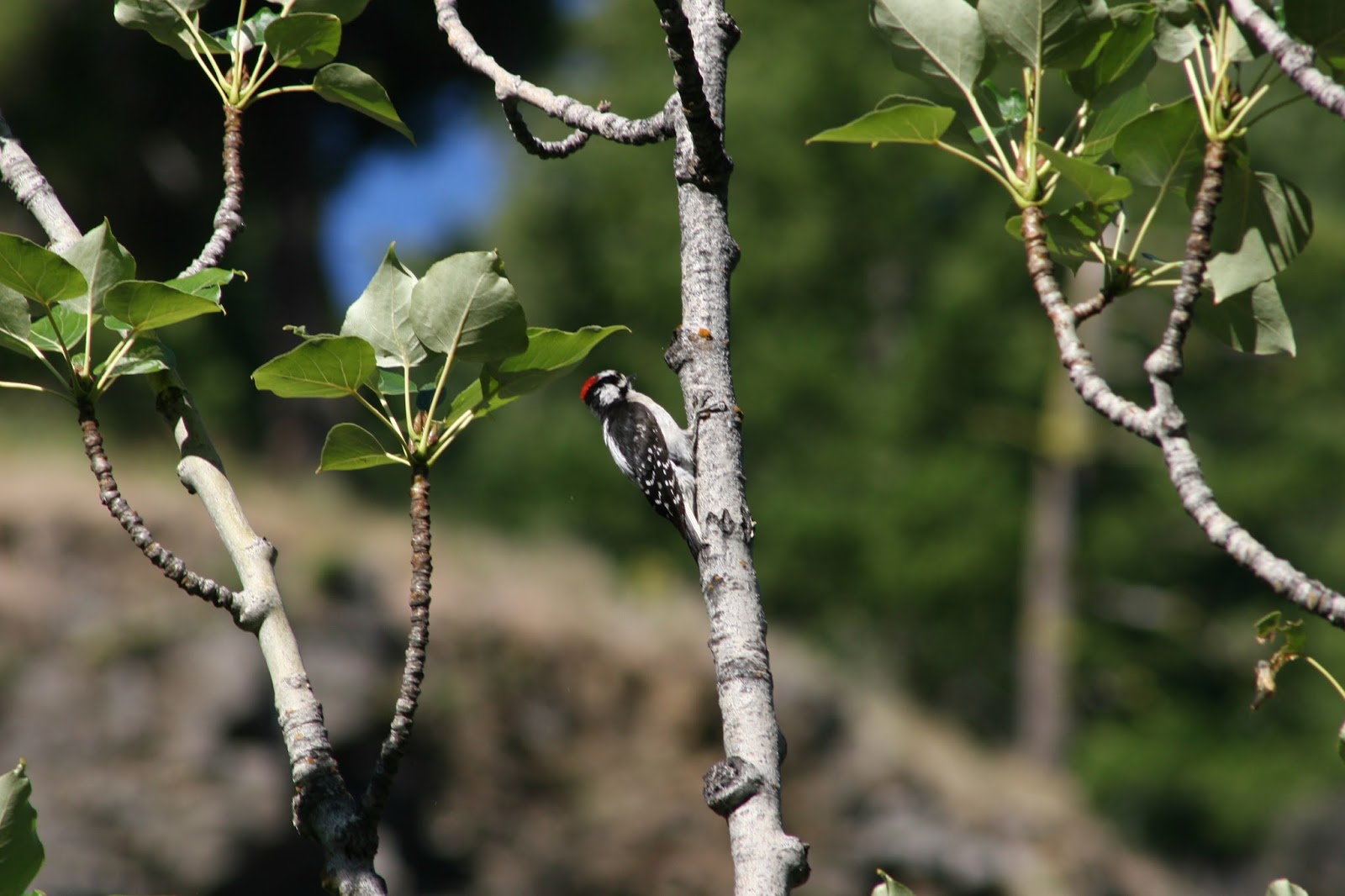
Downy Woodpecker

The smallest species of woodpecker in North America, the Downy woodpecker. I caught this fellow in the early morning light in the Mount Rainer wilderness. 


Catching rays!

I noticed this robin at a rest stop along Highway 395 in Washington (Sprague Lake). At first I thought it was dead, as it was completely motionless, even catatonic. But it wasn't! It was either sunbathing or anting. Anting is when a bird sits prostrate over an ant hill to allow ants to cover its body. It is thought that this helps the bird to rid itself of external parasites. 


Cedar Waxwings

I like both species of waxwings that visit our area, the Cedar (pictured here) and the Bohemian. They don't overlap very much in range, especially in the summer. For identification purposes one of the biggest differences in field marks is the color of the undertail coverts: on the Cedar they're yellow, on the Bohemian they are rusty red. 

These images were taken at Windy Point Campground along the Tieton River in the Mt. Rainer wilderness and at Twin Harbors Campground near Westport, Washington on the central Washington coast. No, not the best images I've ever taken...


Evening Grosbeaks

You don't go out and find these birds; they find you! Suddenly there are Evening grosbeaks and then they're gone. A small flock actually visited our backyard over the course of a few days in late spring. They were especially interested in the water pond for bathing and drinking. But hey, why not grab a snack too?

As is typical with songbirds, the brighter and more colorful of the pair is the male, the other the female. 


Song Sparrow

Note the large spot in the center of the bird's breast. This is a field mark for this bird. But their song is most distinctive. You can listen to it here

The Song sparrow is one of my favorite birds. Honestly they are extremely common and seemingly everywhere. 


Saturday, April 23, 2016

Brewer's Blackbirds

These are the first for the season. They were in my backyard, looking for a meal. I wouldn't be surprised if they had been in my neighborhood last year, too, as migrating birds often head for the same place year after year. While Brewer's can be year round residents where I am, I don't often see them in my backyard during the winter. 

Female above, male below. 


 Male in the lilac bush. Note the distinctive yellow eye.

Saturday, April 2, 2016

Not A Bird....

...but still cool. Here's a beaver dam I discovered. This one is holding back water in a slough of the Clark Fork River near Clark Fork, Idaho. The "reservoir" created by this dam is quite large, more of a small lake than a pond. And lots of waterfowl, mostly Lesser Scaups, Wood Ducks, and the ubiquitous Canada Geese.